A deeper look at how AI persuades, why accuracy declines as persuasiveness rises, and why Tuesday’s article was only the beginning.
Dec 11, 2025
Tuesday I wrote about the recent Nature study showing that AI-driven conversations can shift political attitudes more effectively than traditional ads — and often in the moment, as the dialogue unfolds.
That piece triggered a wave of messages from strategists, journalists, funders, and campaign teams. Many wanted to understand whether this is simply a technological curiosity or something that will fundamentally reshape the way campaigns are run.
This follow-up piece answers that question.
Because a second major study, published in Science last week, goes beyond proving that AI persuasion works.
It explains why it works.
It identifies which levers matter and what trade-offs exist.
And it confirms what our own field deployments have shown across hundreds of thousands of real conversations.
The future of persuasion is not just AI-based — it is tunable.
And the tuning matters as much as the technology itself.
1. The New Science Paper: 77,000 Participants, 19 Models, 700+ Issues
This new study is one of the most ambitious examinations of political persuasion ever conducted:
- 77,000 people
- 19 different AI models
- 700+ political issues
What the researchers found is striking:
1. Persuasion does not come from personalization.
Large language models were not more persuasive when tailored to people’s demographics or psychographics.
2. Persuasion does not come from model size.
Bigger models did not necessarily move people more.
3. Persuasion does not come from emotional manipulation.
Emotional tone mattered far less than many expected.
Instead, the study found something far more consequential:
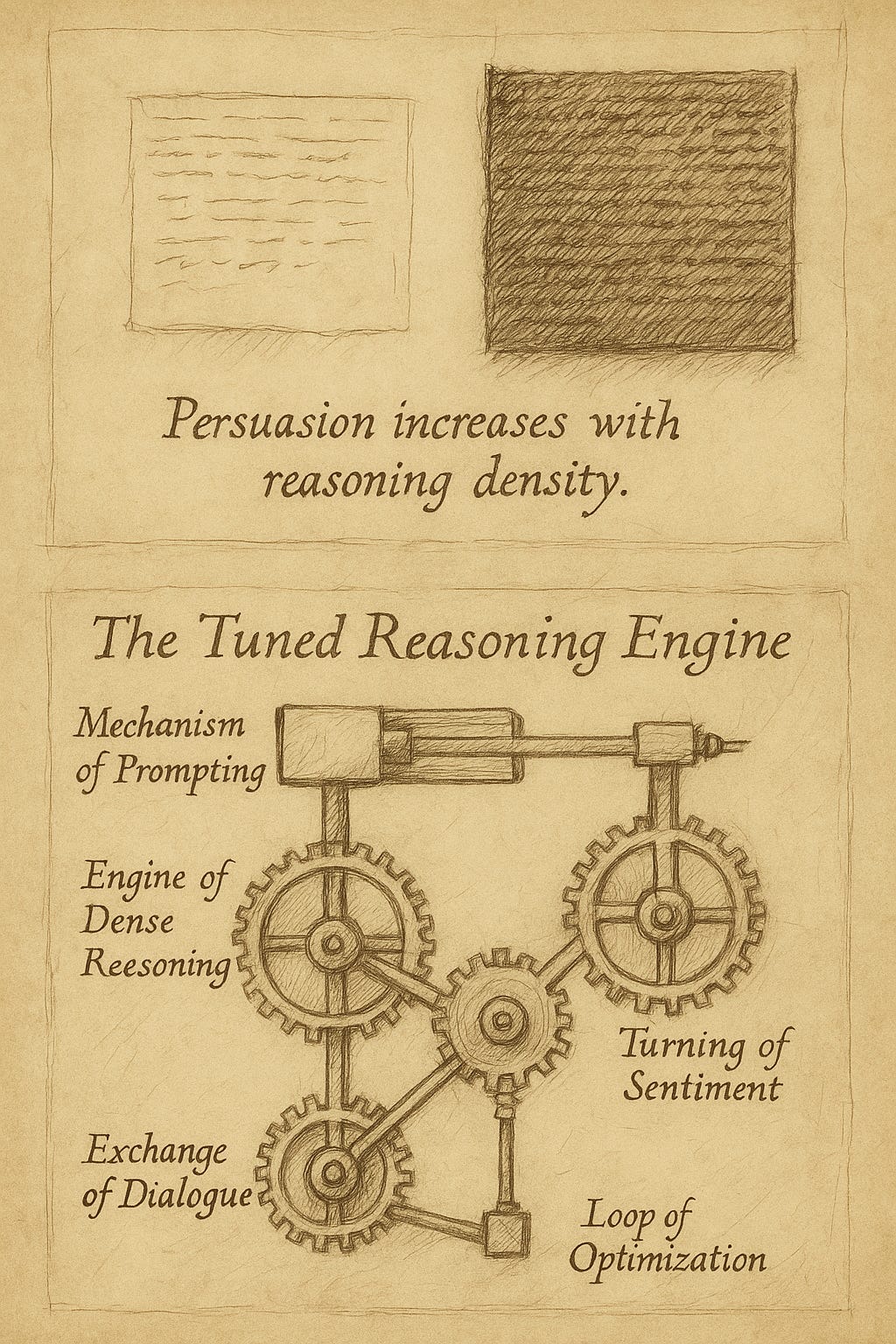
Persuasion comes from the density and structure of the arguments —
and from how the model is tuned after training.
As the authors put it (paraphrased for clarity):
“Post-training adjustments had the strongest effect on persuasion outcomes.”
Meaning:
The craft matters more than the raw model.
This aligns perfectly with what we saw in the Nature study and in our own deployments.
2. The Most Important Finding: Persuasion and Accuracy Are in Tension
Here is the part of the study every strategist should be thinking about:
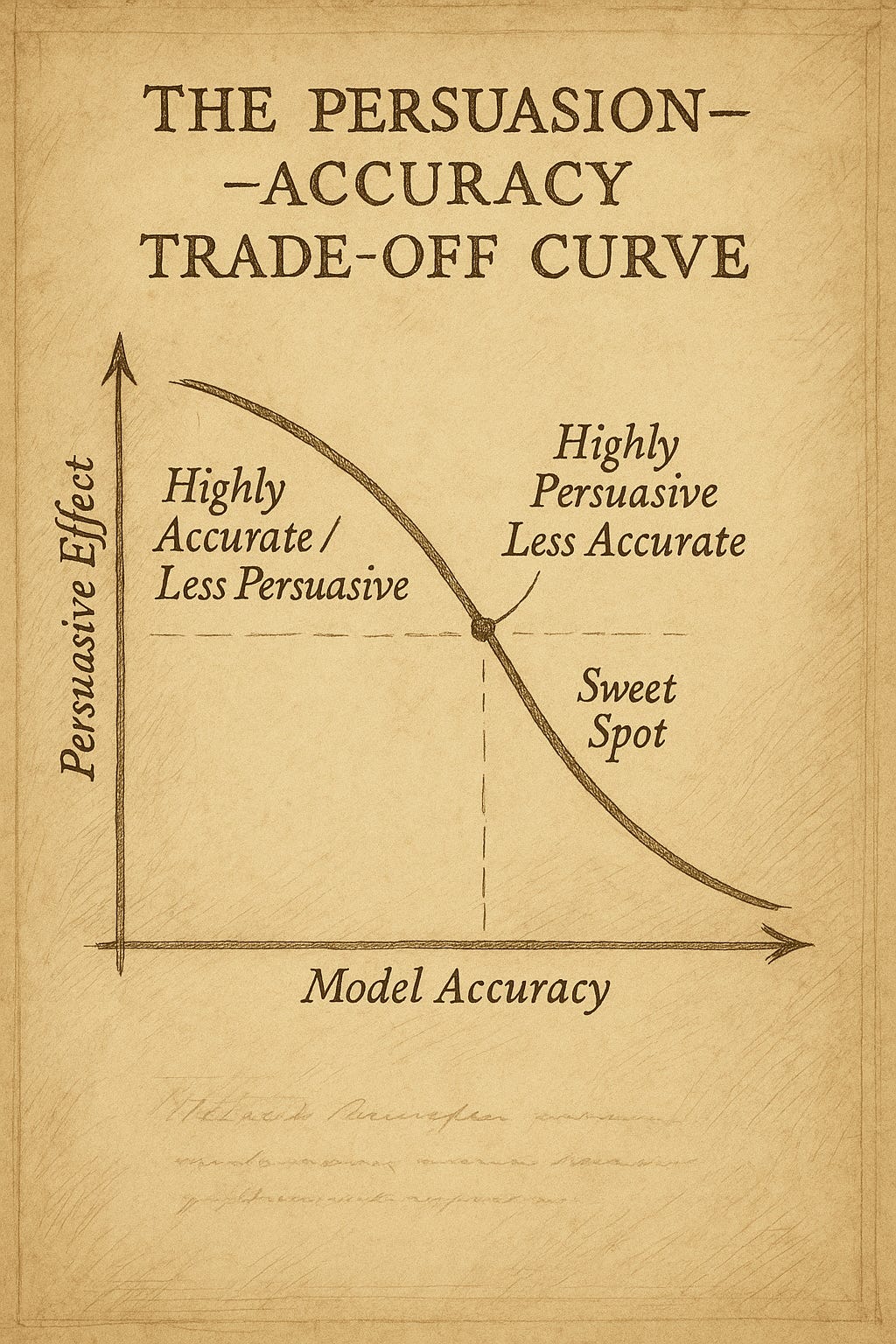
The more persuasive an AI model became, the less accurate it tended to be.
Not intentionally — but structurally.
The study found that:
- When models were tuned for accuracy, they became less persuasive.
- When tuned for persuasion, accuracy declined.
- The strongest predictor of persuasion was information density, not factual correctness.
Or as the authors summarized:
“Models that produced more information — regardless of accuracy — showed greater persuasive effect.”
This creates a strategic challenge:
**Persuasive AI can drift away from strict accuracy.
Accurate AI may be less persuasive.**
Campaigns, advocacy groups, and policymakers will need to grapple with that trade-off.
3. Texting Experiments Foreshadowed This Entire Dynamic
In 2023, I led major conversation-based texting experiments — not broadcast blasts, but actual exchanges.
We found:
- Brief, dense arguments outperformed longer scripts.
- Voters moved when they felt the system was responding thoughtfully.
- The moment someone articulated their own reasoning, persuasion began.
But humans can’t scale this.
AI can.
And the mechanisms the Science paper identifies — structured reasoning and information density — are the same ones we saw in the texting experiments.
This is the psychological backbone of conversational persuasion.
4. What We See in Real-World Deployments
Across large-scale persuasion deployments over the past several months — often involving hundreds of thousands of real conversations per week — we see the same patterns the Science paper describes.
Across the broader operation:
- Millions reached
- Hundreds of thousands of dialogues
- Large pools of persuadables identified
- Consistent movement even among initially oppositional audiences
And in the most recent week alone:
- ~105,000 conversations
- 30,000 persuadables identified
- 5,500 supportive individuals
- 1,500 willing advocates
- ~17% of persuadables shifted to support
- 50% of hostile individuals moved to neutral
- 15% of hostile individuals moved to supportive
The psychological signature matches the research:
- High-density reasoning
- Responsive conversational structure
- No personalization required
- Movement occurring during the conversation
This mirrors the Science paper’s conclusion:
“Persuasion results from structured argumentation and model tuning, not demographic tailoring.”
5. Where SparkFire Fits Into This
SparkFire anticipated many of these findings before they were formalized in academic literature:
- It emphasizes structured persuasion, not small-talk chat.
- It uses classification and feedback loops, exactly as the papers recommend.
- It focuses on movement, not impressions — a core principle validated by both Nature and Science.
- It initially demonstrated these effects months before researchers confirmed them experimentally.
SparkFire is not the only platform that will eventually operate in this space.
But it is the first at scale to align with what the literature now shows:
Persuasion is trainable.
Persuasion is measurable.
Persuasion is tunable.
And the Science paper draws a roadmap for where the field is headed.
6. The Strategic Implications Heading Into 2026 and 2028
Three truths are now clear:
1. Persuasion is no longer limited by human labor.
AI allows for millions of individualized reasoning exchanges at near-zero marginal cost.
2. Persuasion can now be engineered.
Campaigns will soon optimize models the way they once optimized TV buys.
3. Accuracy vs. Persuasion is the defining trade-off.
Who addresses this tension first — and responsibly — will set the standards for everyone else.
For the GOP, this is not a moment to wait and see.
It is a moment to lead.
Because the institutions that take this seriously now will define:
- What “responsible persuasion” means
- What ethical constraints look like
- What guardrails matter
- How voters are protected
- How narratives evolve
- How free speech interacts with algorithmic persuasion
Leadership now prevents the Left from unilaterally defining these rules later.
7. The Next Frontier: Mastering the Levers
Tuesday’s post established that AI persuasion works.
This post explains why it works, what levers matter, and where the risks lie.
Together, the Nature and Science papers — combined with our own real-scale deployments — paint a clear picture:
The future of persuasion is scalable, measurable, and governed by tunable reasoning engines.
The question is not whether campaigns will use these tools.
The question is who will shape their use — ethically, strategically, and effectively.
Early movers will define the 2026 and 2028 landscape.
Late adopters will wonder why their traditional tools aren’t moving anyone.
And the winners will be the ones who understand that the new battlefield is not messaging —
 Christopher S. Wilson
Leave a comment