first published at: https://christopherswilson.substack.com/p/what-i-learned-writing-my-way-through
What Writing in Public Taught Me About Politics, Pressure, and Change
Dec 30, 2025
When I started writing this Substack, I wasn’t trying to build a “content strategy.”
I was trying to understand something that polling, dashboards, and even my own experience in campaigns were no longer explaining well:
Why politics suddenly felt different; and why so many professionals were still reacting too late.
Over the course of 2025, this Substack became a real-time lab for me. Not just for sentiment analysis or AI-driven strategy; but for thinking out loud, pressure-testing ideas, and connecting dots faster than legacy systems allow.
What surprised me most wasn’t which posts performed best.
It was how ideas layered on top of each other over time, turning early intuition into something closer to a framework.
Below are the pieces that defined that journey.
The Early Foundation: Why Polling Was Failing Before Most Admitted It
Some of the most important work I wrote this year didn’t have the biggest audiences, but it shaped everything that followed.

Polling’s Fatal Flaw—and What Replaces It
·Aug 28
“Most campaigns aren’t wrong about the data. They’re wrong about when it matters.”
That post set the tone: polling isn’t obsolete, but it’s incomplete. It measures opinion after emotion has already moved.
That insight echoes an old campaign lesson. In 2016, multiple presidential campaigns had accurate internal polling, but missed how fast sentiment was shifting beneath the numbers. By the time the polls “caught up,” the momentum on the field had already changed.
The same pattern shows up in corporate crises. Think of brands that relied on quarterly brand tracking, only to be blindsided by social backlash that erupted and hardened in days, not months.
The Middle Act: Emotion Becomes Measurable
As the year progressed, the writing got sharper—and so did the audience.

The Persuasion Equation — How Emotion Meets Probability in Modern Campaign Modeling
“Persuasion isn’t about changing minds. It’s about identifying when minds are changeable.”
This was a turning point. Instead of debating whether emotion matters, we started modeling how it behaves: volatility, saturation, decay.
Campaign history is full of examples where this mattered.
Barack Obama’s 2008 operation wasn’t just about message; it was about timing emotion before it calcified.
The same is true in corporate turnarounds: leaders who intervene during emotional volatility win; those who wait for stable metrics lose.
The Core Contribution: The 7 Types of GOP Primary Voters (Series)
The most cumulative work of the year, and the clearest example of ideas compounding, was The 7 Types of GOP Primary Voters series.
Across 7 parts, the project did three things:
- Mapped emotional coalitions (not demographic stereotypes, e.g., “Soccer Moms”)
- Connected sentiment to behavior, not just identity
- Showed how these blocs shift in real time, typically before polling detects movement
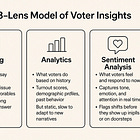
The 7 Voter Types Who Decide Every GOP Primary
“Primaries aren’t decided by averages. They’re decided by which voter type is emotionally activated right now.”
This mirrors something seasoned operatives have always known intuitively. In past primaries, from Tea Party waves to MAGA realignments, the winning campaigns weren’t persuading everyone. They were activating the right voters at the right moment.
The difference now is that we can measure those shifts as they happen, not after Election Day.
The High-Performance Breakouts
A few posts combined timing + relevance + clarity, and the data showed it.
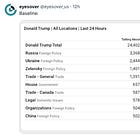
Trump’s Speech Broke the Internet—Here’s the Real-Time Data to Prove It
“What mattered wasn’t what he said. It was how fast people reacted and who reacted first.”

Why Politico Just Spotlighted EyesOver — And What It Means for 2026
“Real-time sentiment isn’t a feature. It’s becoming the operating system.”
These posts worked because they answered a reader’s real question:
What should I be watching right now that I’m probably missing?
What This Year Changed for Me
Writing consistently forced clarity.
I no longer think of sentiment analysis as a tool.
I think of it as early warning radar; for campaigns, companies, and institutions that can’t afford to be surprised.
That realization echoes a hard-earned campaign truth: the cost of being late is almost always higher than the cost of being wrong early.
What I’m Watching in 2026
As we head into 2026, three things are becoming unavoidable:
- Affordability is structural (not cyclical)
- Elite distrust is hardening into identity, not just grievance
- AI-mediated persuasion is moving faster than norms or regulations
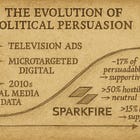
The Coming AI Persuasion War: New Science, Texting Experiments, and What We Just Learned From 100,000 Conversations
Campaigns and organizations that still rely on static snapshots alone (polling) will lose to those that use the three lens approach.
Campaigns and organizations that track emotional momentum continuously will see shifts coming, and act before everyone else understands or agrees they’re real.
That’s what this Substack has become about for me.
 Christopher S. Wilson
Leave a comment