Originally published at: https://christopherswilson.substack.com/p/the-7-voter-types-who-decide-every
And how campaigns fail without the full picture: polling, analytics—and sentiment
Sep 04, 2025
“If you’re only speaking to the base, you’re calling plays for the student section—not the scoreboard.”
2015 Changed Everything
Before Trump, Republican primaries followed a familiar blueprint:
Secure elite endorsements, build early state field ops, and target “very conservative” or “somewhat conservative” voters by polling and turnout history.
But that model shattered in 2016.
Brad Parscale saw this early—before anyone else. And Donald Trump ignored the lanes—and still won. Why?
Because he activated voter types no one was measuring: disaffected populists, cultural backlash voters, and silent resistors who didn’t respond to polls—but did show up to rallies, click on links, and flood Facebook with outrage.
In short:
Parscale read the sentiment before the pollsters (me at the time) asked the question.
Since then, Republican primary voters have only gotten more fragmented and more behaviorally dynamic. The base is no longer a bloc—it’s a battlefield of motivations, identities, and trigger points.
Why Polling Isn’t Enough—And Never Was
Polling still matters. So does historical data.
But if that’s all you’re using, you’re flying blind.
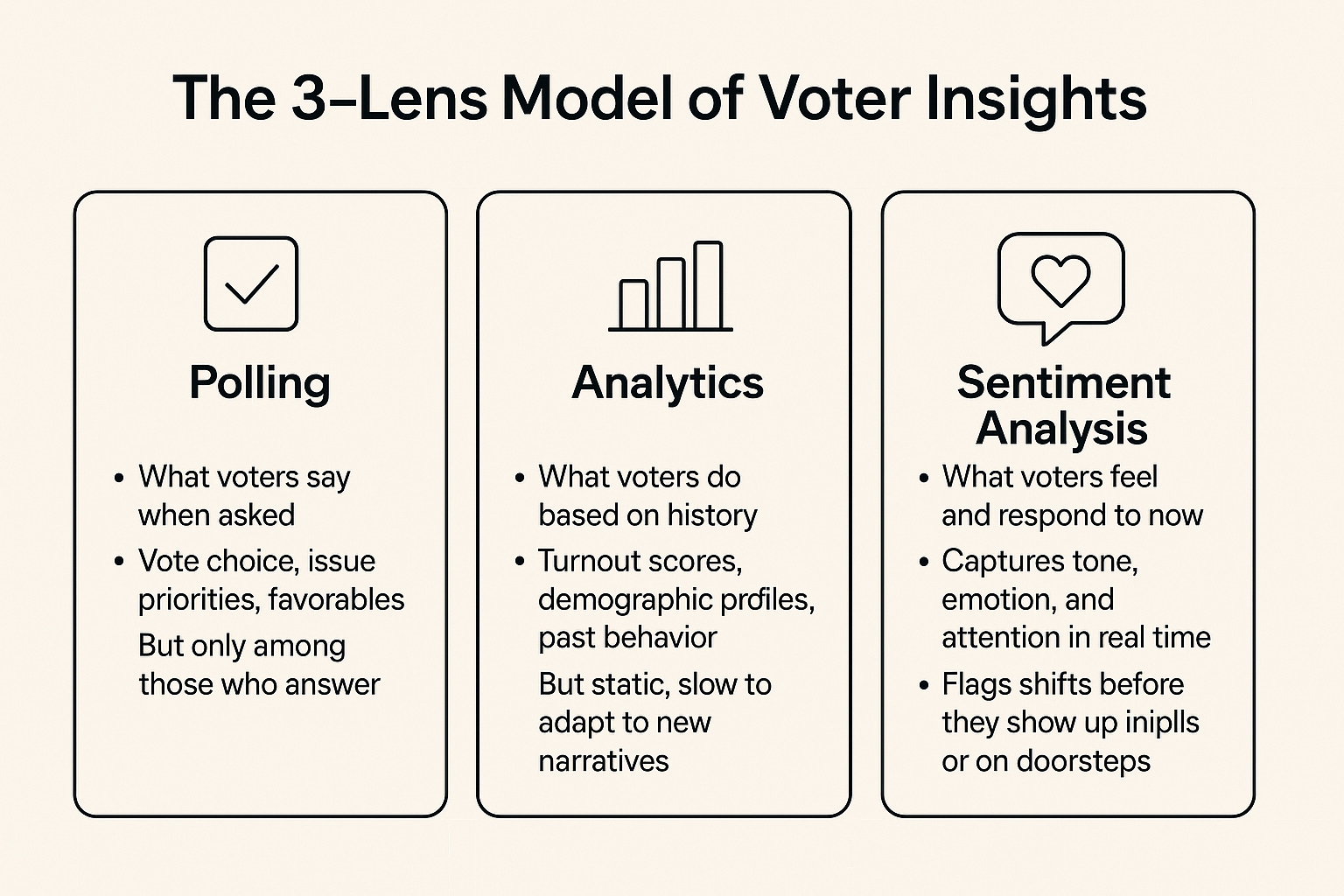
Every effective campaign now needs three lenses to see the real electorate:
1. Polling– What voters say when asked
- Vote choice, issue priorities, favorables
- But only among those who answer
2. Analytics – What voters do based on history
- Turnout scores, demographic profiles, past behavior
- But static, slow to adapt to new narratives
3. Sentiment Analysis – What voters feel and respond to now
- Captures tone, emotion, and attention in real time
- Flags shifts before they show up in polls or on doorsteps
Political scientists like Liliana Mason (Uncivil Agreement) and scholars from the Computational Propaganda Project at Oxford have shown how identity and emotion now drive voter behavior more than ideology.
That’s why tracking real-time sentiment—not just preferences—is now mission-critical.
This landmark report analyzes how governments and political actors use social media to manipulate public sentiment, especially through emotional triggers and identity reinforcement. It shows that the modern political battlefield is shaped less by ideology than by reactive emotion, tribal identity, and narrative control—making traditional polling blind to many key shifts.
“As political communication increasingly moves to digital platforms, public opinion is shaped less by ideology and more by the manipulation of emotion and identity online.”
— Bradshaw & Howard, Oxford Internet Institute
What You’re Likely Missing
If your campaign is only optimizing for:
- MAGA turnout (“check the crosstabs!”)
- High-propensity primary voters (“let’s target 4 of 4s!”)
- Issues already polling well with the base (“it’s an 80-20 issue!”)
…then you’re missing the five voter types who swing elections at the margins.
These “hidden” voters:
- Don’t always pick up the phone
- Don’t fit your modeled universes
- Don’t show up in favorability tests
But they do react—hard and fast—to cultural moments, media flashpoints, and narrative framing.
And you can’t find them with polling alone.
The 3-Lens Model in Action
When a state quietly advanced a controversial gender policy for schools, the EyesOver dashboard lit up—before a single headline was written.
Among conservative women, sentiment spiked: anger, fear, urgency.
Polling didn’t capture it—no one had asked.
But the campaigns that caught the wave in time flipped their messaging—and unlocked one of the most powerful voter types in modern GOP politics:
The Backlash Parent.
That’s the power of integrated political intelligence. Not just listening after the fact—but adjusting before the moment peaks.
Get Ahead, or Get Caught Flat-Footed
This series maps the seven voter types every GOP campaign must understand:
- Based on real-world behavior, not theory
- Grounded in post-2016 data and case studies
- Designed to help you see what your opponent doesn’t
 Christopher S. Wilson
Leave a comment