Dec 09, 2025
Last week, Nature published a landmark study (here’s the magazine verion) demonstrating something political strategists have long suspected but never had definitive proof of:
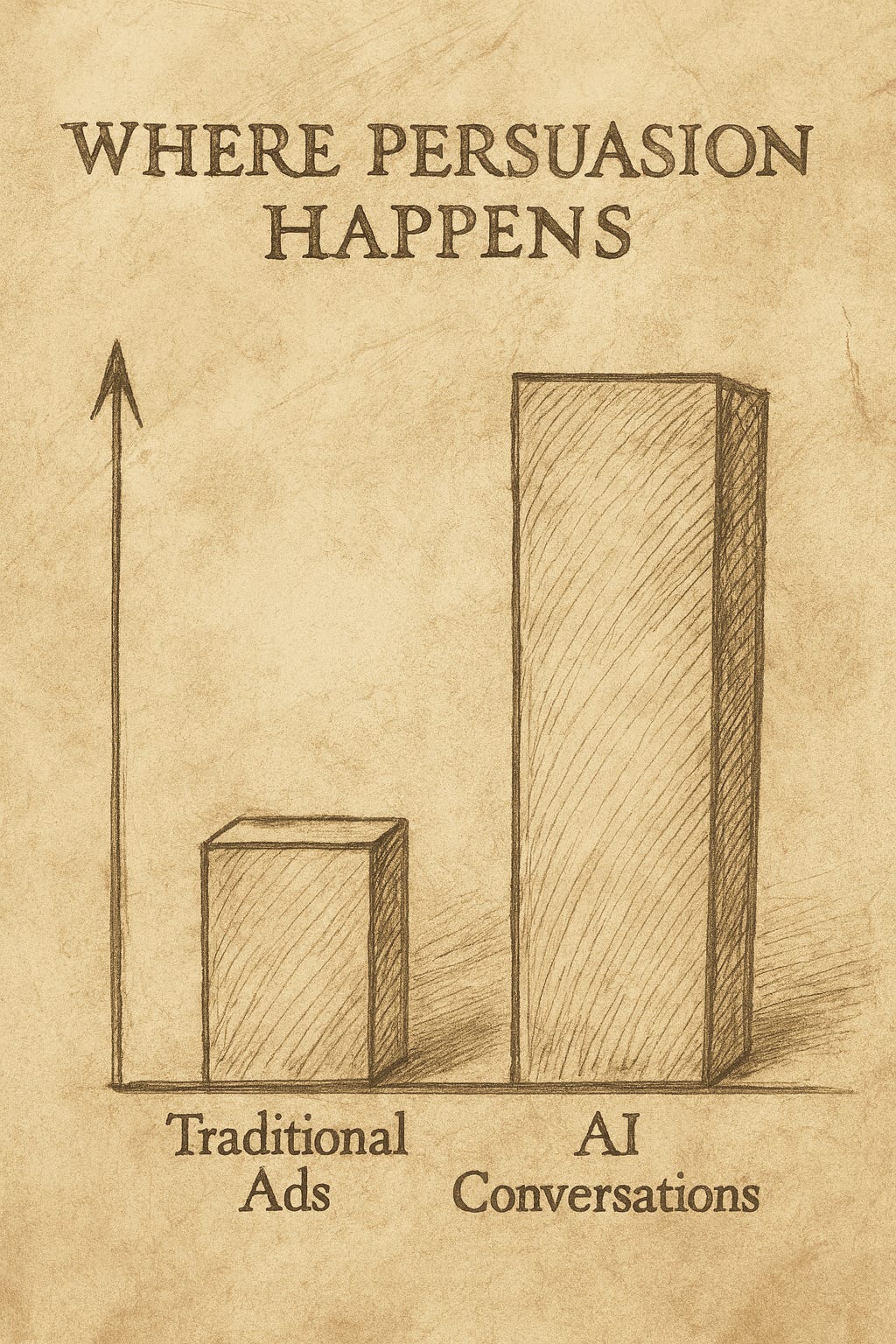
AI-driven conversations can meaningfully shift voter attitudes, often more effectively than traditional TV ads.
On its own, that’s a major academic milestone.
But when you combine this research with two additional streams of evidence:
- Texting-based persuasion experiments I led last cycle, and
- Recent real-world results from SparkFire, an AI-powered conversational engagement platform,
…an undeniable pattern emerges:
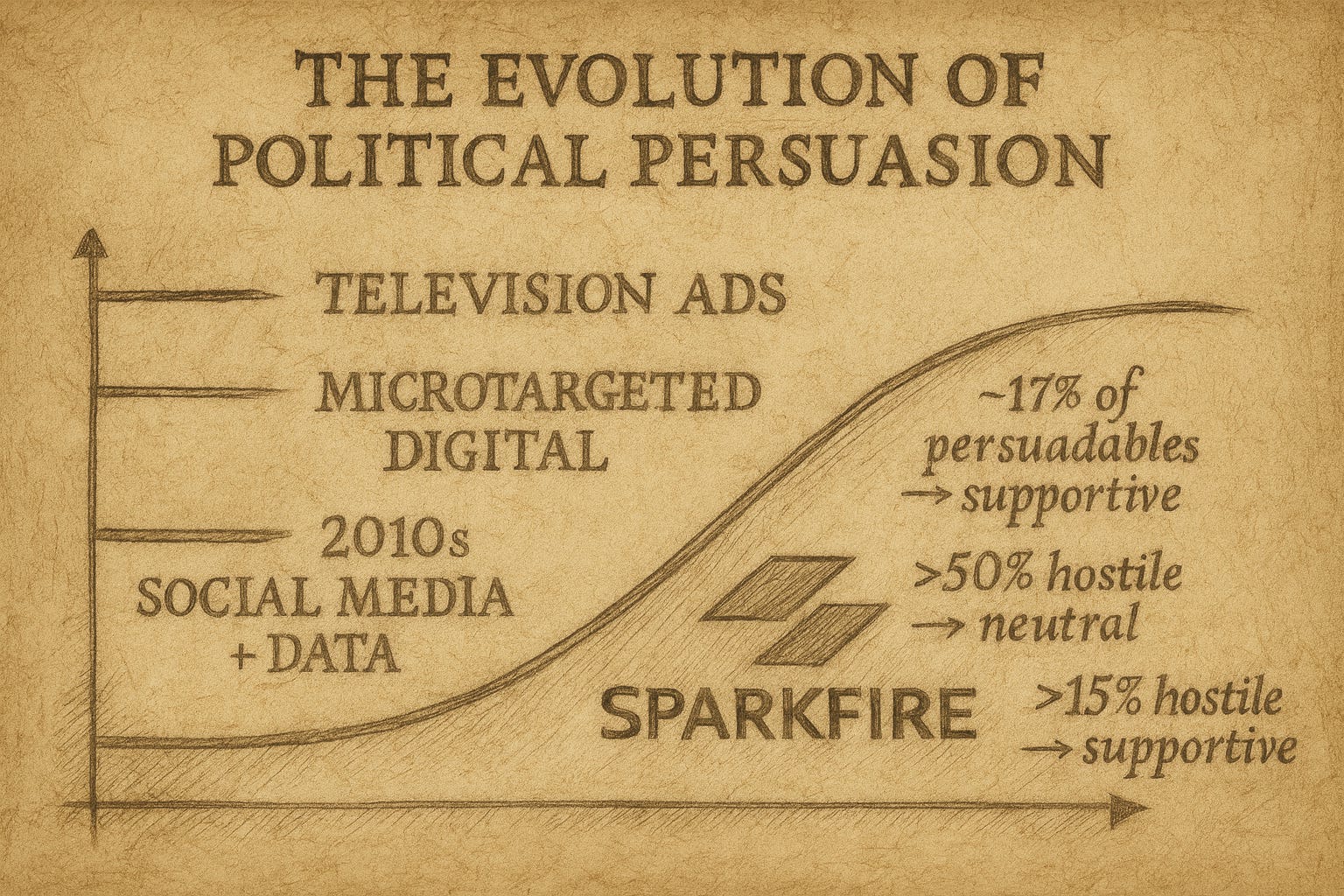
We are entering the era of scaled, personalized, conversational persuasion.
And the campaigns, corporations, and advocacy groups that adapt first will gain a structural advantage that will be difficult to replicate later.
1. The Science Arrives: AI Conversations Outperform Traditional Advertising
The Nature study tested AI persuasion across multiple countries and political systems. The findings were unmistakable:
- AI conversations changed people’s minds
- They worked faster than conventional media
- They were effective across issues and voter types
- They outperformed video ads
- Tailored reasoning, not slogans, drove the effect
This wasn’t turnout modeling.
It wasn’t brand lift.
It was actual opinion change: the holy grail of political communication.
Most importantly:
Attitude shifts occurred during the conversation.
Not days later.
Not after repeated ad exposure.
Not after 1,000 GRPs.
The moment voters articulated their reasoning, they became persuadable.
That insight leads directly to the next chapter in this story.
2. Before AI, Texting Experiments Pointed the Way
In spring 2023, I led one of the earliest well-funded studies examining whether two-way texting conversations, not blasts, not reminders, but real dialogue, could persuade voters.
The results were ahead of their time:
- Even short exchanges moved opinion
- Voters reacted to tone, not length
- Persuasion began when people felt heard
- Effects were modest but reliable
But there was one major limitation:
Humans don’t scale.
You can’t deploy 50,000 trained conversational volunteers across every demographic and geography.
The concept was right.
The infrastructure wasn’t there yet.
AI changed that.
But AI alone isn’t enough.
You still need:
- Targeting
- Segmentation
- Sentiment classification
- Persuasion measurement
- Iterative optimization
This is where SparkFire becomes relevant—not as the only solution, but as the first platform to operationalize conversational persuasion at real-world scale.
3. What Conversational AI Looks Like Outside the Lab
While academic researchers were testing whether AI persuasion was even possible, SparkFire was already demonstrating what it looks like in practice:
AI persuasion works at scale, at low cost, and with measurable movement in real time.
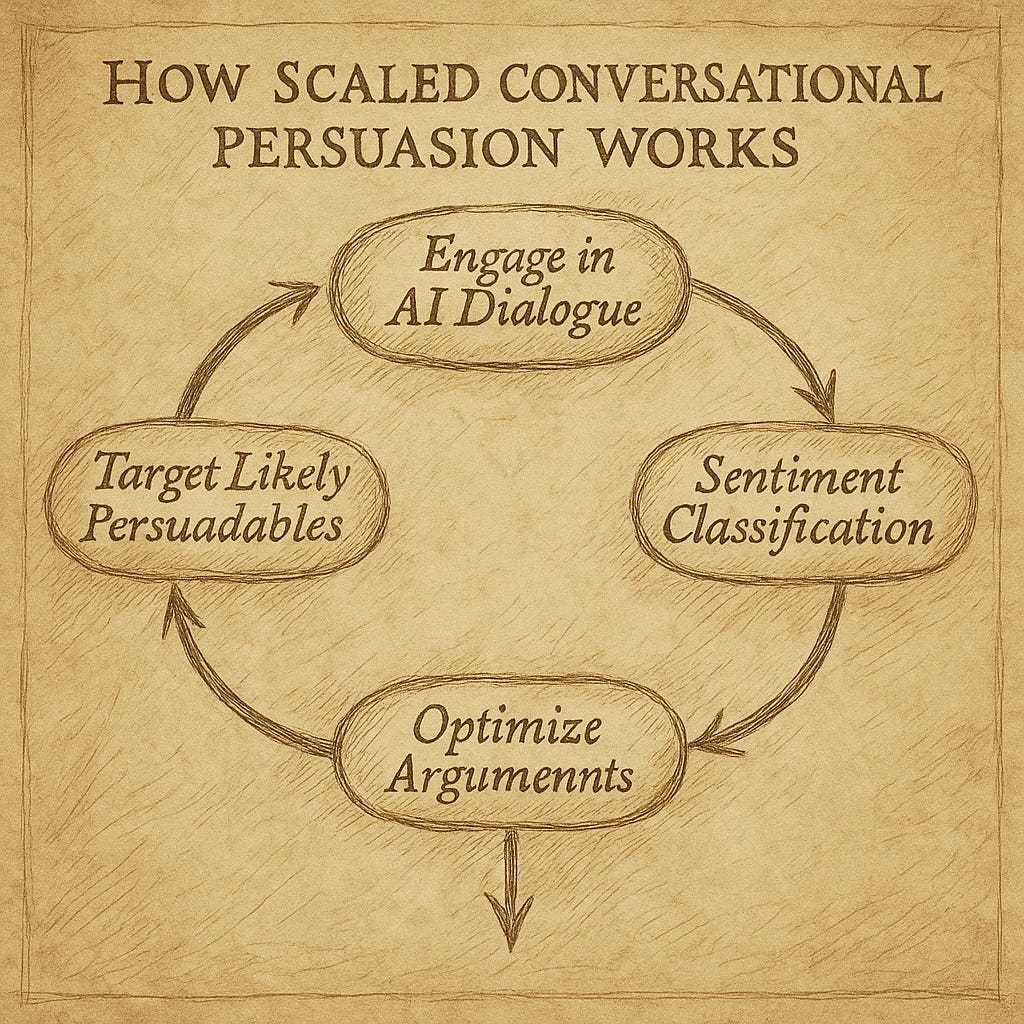
Over the past several months, SparkFire has been running one of the largest ongoing persuasion initiatives in the country. Its objectives were straightforward:
- Reach the correct audiences
- Engage them in dialogue
- Classify their sentiment
- Persuade where possible
- Measure movement
- Learn and adapt
The results have been consistently strong.
4. Longer-Term Patterns: Millions Reached, Hundreds of Thousands Engaged
Across its deployment to date, SparkFire has achieved:
- Millions of individuals reached
- Hundreds of thousands of conversations
- Large, identifiable pools of persuadables
- Meaningful movement among neutral and oppositional audiences
- Steady growth in supporter and advocate identification
The ratios vary with audience and message, but the pattern is clear:
- When people talk, they move.
- When they articulate beliefs, they open themselves to reconsideration.
- When they are engaged respectfully, persuasion becomes measurable.
And in the most recent week of operations, the clarity of this model sharpened.
5. What We Learned From ~100,000 Conversations in One Week
Seven-Day Performance Snapshot (Anonymized)
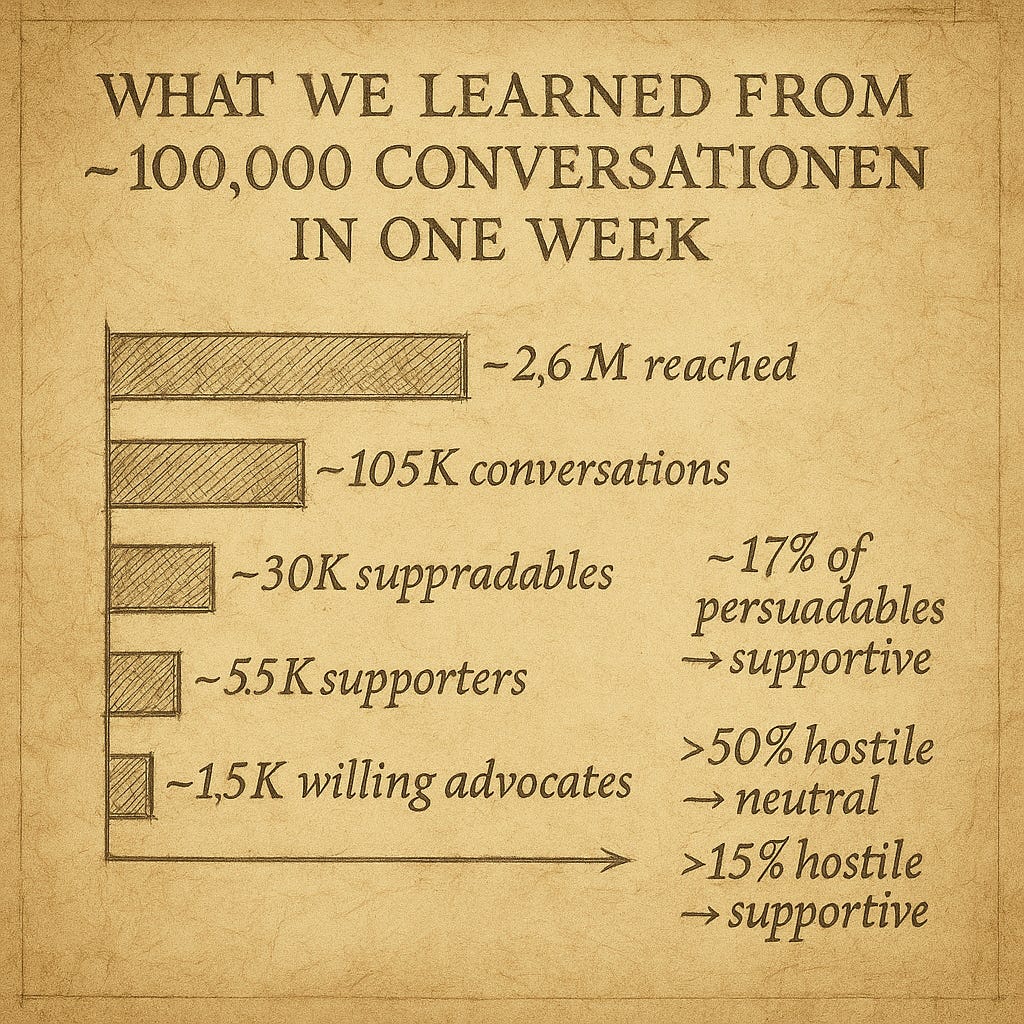
- Reach: ~2,600,000
- Conversations: ~105,000
- Interaction Rate: 4.6%
- Cost Per Interaction: $2.84
From those conversations:
- 5,500+ confirmed supporters
- 30,500+ persuadables identified
- 1,500+ willing advocates
And the persuasion effects:
Measured Movement in One Week
- ~19,500 persuadables (Over 17%) shifted into support
- Among ~15,000 initially hostile individuals:
- 50%+ moved to neutral
- 15%+ moved into support
That means roughly two-thirds of hostile individuals became neutral or supportive during a single AI dialogue.
This is not theoretical.
This is not a forecast.
This is observed movement as it happens.
It is what political operatives have spent decades trying to quantify.
And while SparkFire is the first to demonstrate this at real scale, it almost certainly will not be the last.
Others will enter this space.
But SparkFire has a meaningful head start.
6. Why SparkFire Is Early to This—And Why Others Will Follow
Many AI tools can “chat.”
Almost none can persuade with measurable outcomes.
SparkFire’s early lead comes from integrating:
• Precision targeting
Through predictive and behavioral audiences (e.g., those developed at Stratus), SparkFire focuses on people who can actually be moved.
• Conversational reasoning models
Not generic ChatGPT-style interactions; structured persuasion built around values, logic, and relevance.
• Real-time sentiment classification
Knowing who is supportive, neutral, hostile, or persuadable, and how they shift.
• Movement-focused analytics
Clicks aren’t persuasion.
Impressions aren’t impact.
Movement is.
• Scalable infrastructure
Tens of thousands of conversations per day.
Millions per month.
SparkFire isn’t the final word in this field, of course; innovation will accelerate, and more platforms will emerge.
But as of today, SparkFire is the first proven operational model of large-scale, measurable AI persuasion outside the academic environment.
7. Why This Matters for the GOP
For Republicans, this isn’t just technological disruption.
It is a strategic need.
The Right performs best when it:
- Speaks directly to voters
- Bypasses legacy media
- Leads with values
- Builds relational trust
- Personalizes persuasion
AI conversational engagement accelerates all five.
Progressive groups will adopt this quickly.
Major Left Wing institutions will fund their experimentation.
Silicon Valley will shape defaults that do not favor conservatives.
The Right must engage early; not to match Silicon Valley, but to ensure pluralism and balance in how these tools are deployed.
AI persuasion doesn’t remove the need for message strategy.
It enhances the ability to deliver that strategy at depth and scale.
8. The Persuasion War Has Begun—And Early Movers Have the Advantage
The Nature study provides scientific legitimacy.
The texting experiments offered the conceptual framework.
SparkFire now provides the field-tested operational blueprint.
The future belongs to organizations that:
- Treat conversations, not ads, as the persuasion unit
- Use data audiences to target the movable
- Measure movement, not impressions
- Adapt messaging dynamically
- Understand AI as an enabler, not a replacement for strategy
SparkFire is early to this space.
Others will follow.
But early movers will enjoy compounding advantages heading into 2026 and 2028.
The persuasion battles of the late 2020s will not be won through noise, spending, or volume.
They will be won one conversation at a time.
And the platforms that master conversational persuasion, starting now, will define the next era of political communication.


 Christopher S. Wilson
Leave a comment